Employer product
Quzo.ai
From a question to an assessment.
AI-assisted question creation, assessment delivery and response reporting.Explore the architecture
Take a closer look.
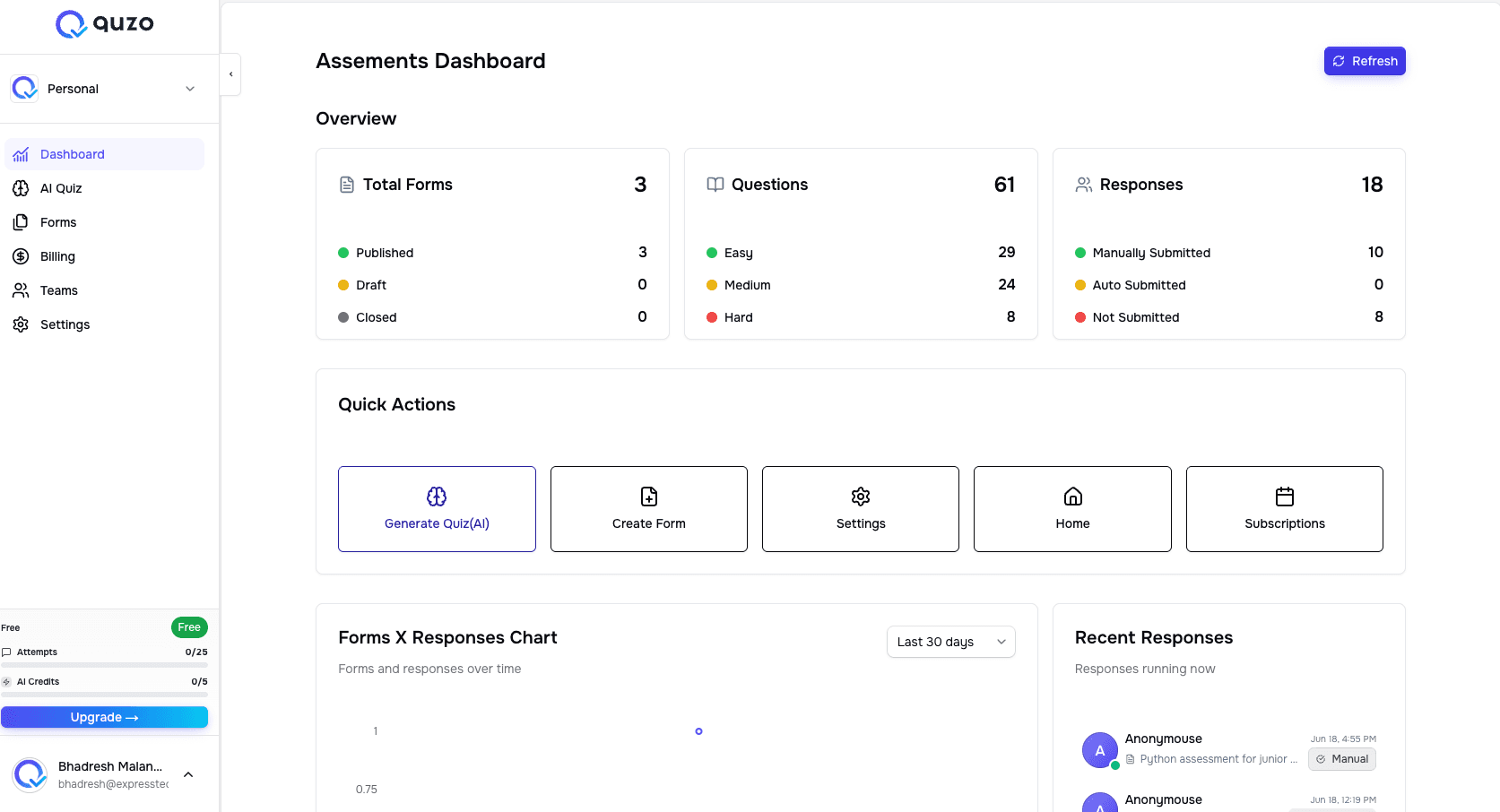
01 / 06Assessment dashboard.
Browse all 6 screenshots +
Built today.
Designed to scale.
Two modular applications.
Different workloads. Room to grow.
The exam application reads recurring definitions from Redis. Answers go to the response primary; the cache is never the record of a submission.
Educators
& learners
Browser requests
Forms & admin
BuiltOne application, clear module boundaries.
Exam delivery
BuiltNode.js · extra capacity planned
Redis
BuiltShared read cache
Forms + admin data
Answers, kept separate
An exam starts. The traffic arrives together.
Exam delivery is separate from form administration. Redis reduces repeated fetches; responses go to their own database. Explore the next step: independent exam capacity.
- 01Learner starts an exam
- 02Node.js serves the session
- 03Redis supplies repeated reads
- 04Responses commit to the primary
Open the engineering notes
Why two modular monoliths?
Forms and exams have different traffic patterns. Each remains one deployable application with internal modules, keeping changes easier to reason about while allowing independent application scaling.
What happens to cached data?
Repeated, authorized reads can use cache-aside. Keys need workspace and version boundaries, an expiry, and invalidation after edits. A cache miss falls back to the database; answers bypass the cache.
What does autoscaling need?
The scale plan uses requests per instance or utilization, with latency as a health signal. Keep warm capacity, cap database connections and store sessions outside individual processes. Drain in-flight requests before scale-in; submission retries need idempotency and bounded backoff.
Where are the limits?
Replicas can lag; they do not increase primary write capacity. Failover needs a tested recovery path. Load tests, connection limits and recovery drills must establish capacity before publishing a concurrency or availability claim.
Built: Forms, Exams and shared Redis. Planned: load-balanced exam autoscaling, HA standby and read replicas. Shown instance counts explain the design; they are not a deployment inventory or a concurrency benchmark.
The starting point
Creating and running an assessment involves more than generating a list of questions: educators also need delivery, controls and useful reporting.
Where I came in
I worked across the assessment interface, AI integrations, backend workflows and product delivery.
- 01
Connect question generation to the assessment workflow rather than treating AI as a separate chat window.
- 02
Support different model providers behind a shared credit system.
- 03
Keep exam delivery, proctoring and reporting understandable for both educators and respondents.
A little more context
Quzo.ai is presented here as employer-product engineering. Technical responsibility does not imply founder or legal ownership.
The product combines AI-assisted authoring with the practical work of administering assessments and understanding the results.
An integrated question-to-assessment workflow.
Multi-provider AI integration and credit management.
Product screens covering setup, delivery, reports and billing.
- Next.js
- React
- Node.js
- OpenAI
- Claude
- Gemini
- PostgreSQL
- pgvector
- Stripe
ExtendedForms.io
B2B SaaS

A product starts with a conversation.
Let’s have one